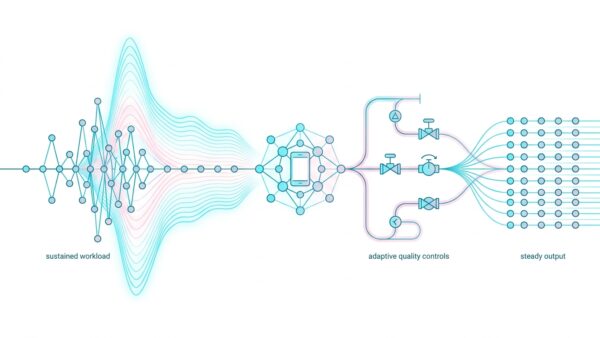

On-device inference creates four release risks before model quality enters the discussion: first-use downloads, hidden preprocessing time, memory pressure, and thermal drift across the supported fleet. A warm benchmark can omit image decoding and UI publication. After several minutes of sustained work, a model that fits on a flagship can push an older phone into memory pressure. Product engineering owns these failures alongside the machine learning work.
On-device AI mobile apps: mobile applications that run machine learning inference on the user’s phone through an operating-system service or an app-bundled runtime. Local execution can keep a bounded task available offline, reduce network exposure of sensitive input, and remove a server round trip. It also moves model delivery, hardware variance, thermal behavior, and fallback design into the app team’s release process.
Ask whether a specific feature can meet a quality contract across the supported device fleet. That contract needs an input boundary, an output schema, a measurement method, a privacy rule, and a fallback. A team can otherwise optimize inference latency while the actual user gesture remains slow or unreliable.
This guide develops two artifacts that framework tutorials often omit. First, the Local Inference Suitability Matrix scores a task before implementation. Second, the release contract turns quality, responsiveness, availability, security, and rollback into explicit acceptance criteria. The article then dissects four mechanisms that can break an otherwise convincing build: feature availability as runtime state, hardware delegation with partial fallback, task-sensitive quantization, and model activation as a verified transaction.
The intended reader is a mobile engineer, ML engineer, or technical lead planning a production feature rather than a benchmark showcase. The examples cover platform-managed models, LiteRT, Core ML Tools 9.0, and ExecuTorch 1.3.1, but the engineering method stays useful when those runtimes change. The version names define compatibility boundaries; release evidence still has to identify the exact package artifact, app build, operating system, and device used in each run.

The feature contract comes first
Receipt field extraction has a finite input and a checkable output. Message classification, keyboard suggestions, and short summarization can share that shape. By comparison, open-ended research over a large changing corpus needs current remote knowledge and a much wider context window.
Write the contract before choosing a runtime. “Add AI to receipt capture” gives engineering no finish line. A better contract names the accepted image types, the fields to return, the supported devices, and what the user sees when confidence is low. Keep two separate fields for timing and quality: one contains the launch threshold chosen by product, while the other contains results measured from the candidate build.
Consider an explicitly hypothetical receipt feature. The product team could propose a p95 end-to-end response budget of 500 ms on its supported-device list, require every extracted total to remain editable, and route low-confidence results to manual entry. Those values are planning inputs that the pre-release device run must replace with measured p50, p95, peak memory, and correction rate for each required tier.
Model profilers usually begin after tensor preparation and stop before the result reaches the screen. Camera conversion, orientation correction, tokenization, allocation, queueing, and view updates can dominate a short inference call. The following Kotlin trace uses Android’s monotonic clock and emits stage durations without the prompt or result payload.
import android.os.SystemClock

data class InferenceTrace(
    val actionNs: Long,
    val inputReadyNs: Long,
    val inferenceStartNs: Long,
    val inferenceEndNs: Long,
    val publishedNs: Long,
    val modelId: String,
    val route: String,
) {
    fun asTelemetry(): Map<String, Any> = mapOf(
        "input_ms" to (inputReadyNs - actionNs) / 1_000_000.0,
        "queue_ms" to (inferenceStartNs - inputReadyNs) / 1_000_000.0,
        "inference_ms" to (inferenceEndNs - inferenceStartNs) / 1_000_000.0,
        "publish_ms" to (publishedNs - inferenceEndNs) / 1_000_000.0,
        "total_ms" to (publishedNs - actionNs) / 1_000_000.0,
        "model_id" to modelId,
        "route" to route,
    )
}

class TraceClock {
    fun nowNs(): Long = SystemClock.elapsedRealtimeNanos()
}
Capture one timestamp at each boundary and construct the record only after the UI publishes the result. The interval names make ownership visible: mobile input preparation, runtime queueing and inference, then UI publication. Device tier, thermal state, and candidate build belong beside this record; raw input and generated content don’t.
- Define the task-level error that matters to the user, such as an edited receipt total or a rejected suggestion.
- Keep a deterministic or manual fallback available from the first prototype.
- Segment measurements by device class and thermal state instead of publishing one fleet-wide average.
- Record model identity and route without logging the user’s private input.
The Local Inference Suitability Matrix
A notes summarizer may earn full points for sensitive input and offline value, then lose most of them because the active fleet can’t support the required model. A receipt classifier can score the other way: modest privacy benefit, broad fleet support, fixed labels, and an excellent manual fallback. Score each matrix dimension from 0 to 3. A total of 15 or more justifies a device prototype; below 10 points toward cloud or deterministic processing; the middle range calls for a hybrid spike with a written kill criterion.
| Dimension | 0 points | 1 point | 2 points | 3 points |
|---|---|---|---|---|
| Offline value | 0: none | 1: occasional | 2: frequent | 3: feature must work offline |
| Input sensitivity | 0: public data | 1: low sensitivity | 2: personal content | 3: regulated or intimate content |
| Task boundary | Open research | Broad generation | Constrained generation | Fixed schema or labels |
| Fleet fit | Unsupported majority | Flagships only | Most active devices | Entire supported fleet |
| Fallback quality | No safe fallback | Disruptive fallback | Cloud with consent | Clean manual or rules path |
| Update tolerance | Knowledge changes hourly | Changes weekly | Periodic model update | Stable domain |
Fleet quality and a safe fallback are independent suitability gates. Sensitive input increases the value of local execution, while a feature belongs on a server when the required devices miss the quality contract. An offline equipment-inspection classifier offers a clearer matrix case: broad fleet support, fixed labels, and a manual checklist can outweigh a modest privacy benefit.
Weights can change by product. A medical app may make input sensitivity mandatory, while a field-service app may assign that role to offline operation. The override needs a named owner because the same raw score can encode two materially different release decisions.
Platform service, bundled runtime, or hybrid?
Who owns distribution, compatibility, and failure recovery? With a platform service, the operating system manages model delivery and hardware integration. Bundling the runtime moves model identity, conversion, and cross-platform behavior into the app team’s hands; a hybrid policy adds a route decision for every request. That ownership choice reaches far beyond inference code because it determines which team can repair a broken device state.
| Criterion | Platform-managed model | Bundled runtime | Hybrid policy |
|---|---|---|---|
| Model control | Limited | High | Policy-dependent |
| Download ownership | OS or system service | App team | Both paths |
| Cross-platform parity | Low | Higher | Explicitly managed |
| Offline behavior | After feature availability | After model installation | Route-specific |
| Best fit | Supported standard task | Custom model and reproducibility | Mixed fleet or risk-sensitive task |
Google’s ML Kit Prompt API documentation exposes four feature states: UNAVAILABLE, DOWNLOADABLE, DOWNLOADING, and AVAILABLE. That state machine matters more than a compile-time support check. A nominally supported device can still need a feature download or system initialization before inference works.
The broader ML Kit GenAI overview adds two operational states that a happy-path sample can miss. AICore can return ErrorCode.BUSY after a burst of requests and ErrorCode.PER_APP_BATTERY_USE_QUOTA_EXCEEDED after sustained use. It also blocks inference when the app isn’t the top foreground application with ErrorCode.BACKGROUND_USE_BLOCKED. Treat these as route inputs: bounded retry for transient busy responses, visible deferral for battery quota, and no hidden background job that can never succeed.
The current Prompt API capability page accepts text-only or combined image-and-text input and can return either text or structured output. That flexibility raises the release burden: unlike the feature-specific Summarization, Proofreading, Rewriting, and Image Description APIs, a custom prompt needs its own prompt corpus, schema checks, and quality assurance. Prefer a feature-specific API when its fixed behavior matches the product task; use Prompt API when customization is worth owning those controls.
Bundled runtimes shift that responsibility to the app. LiteRT focuses on converted models and hardware delegates. Core ML integrates models with Apple’s execution stack, while Core ML Tools 9.0 handles conversion and optimization. ExecuTorch 1.3.1 keeps PyTorch export and backend lowering close to deployment; its export and lowering documentation describes backend-specific lowering for target hardware. Google’s current Prompt API setup page specifies com.google.mlkit:genai-prompt:1.0.0-beta2, while the Summarization API page specifies com.google.mlkit:genai-summarization:1.0.0-beta1. Mixing those coordinates with code written for a different beta can turn an apparently supported route into a build or runtime failure.
A hybrid route is usually the safest answer for a broad fleet. It can keep private short inputs local, ask for consent before a cloud path, and retain manual completion when neither model route is available. Define one route-neutral result schema and record which route produced it, then make correction and cancellation behave identically in the UI.
Availability is runtime state
A user taps Summarize after installing the app and sees the model-download state. The next device is waiting for AICore initialization. An unlocked phone reports the route as unavailable. One generic error would make these different states look like random breakage, so the interface needs to reflect the runtime report after installation.
The Android documentation gives a concrete example. The Prompt API depends on AICore and lists binding failure 601 plus feature-not-found error 606 among setup failures. The same page says an unlocked bootloader isn’t supported for that API. The state handler below follows the four documented feature states and keeps download progress separate from inference readiness.
import com.google.mlkit.genai.common.DownloadStatus
import com.google.mlkit.genai.common.FeatureStatus
import com.google.mlkit.genai.prompt.Generation

sealed interface PromptUiState {
    data object Unsupported : PromptUiState
    data object Ready : PromptUiState
    data object WaitingForDownload : PromptUiState
    data class Downloading(val bytes: Long) : PromptUiState
    data class RecoverableError(val message: String) : PromptUiState
}

suspend fun preparePromptFeature(
    publish: (PromptUiState) -> Unit,
) {
    val model = Generation.getClient()
    when (model.checkStatus()) {
        FeatureStatus.UNAVAILABLE -> publish(PromptUiState.Unsupported)
        FeatureStatus.DOWNLOADING -> publish(PromptUiState.WaitingForDownload)
        FeatureStatus.AVAILABLE -> publish(PromptUiState.Ready)
        FeatureStatus.DOWNLOADABLE -> model.download().collect { status ->
            when (status) {
                is DownloadStatus.DownloadStarted ->
                    publish(PromptUiState.Downloading(0))
                is DownloadStatus.DownloadProgress ->
                    publish(PromptUiState.Downloading(status.totalBytesDownloaded))
                DownloadStatus.DownloadCompleted ->
                    publish(PromptUiState.Ready)
                is DownloadStatus.DownloadFailed ->
                    publish(PromptUiState.RecoverableError(status.e.message ?: "download failed"))
            }
        }
    }
}
Production error mapping belongs one layer above this adapter. Preserve the draft after a binding failure and offer retry. Feature-not-found routes to manual completion or an explicitly consented cloud path. The operational event carries the documented code and state, with the prompt excluded from telemetry.
“Works offline” has a setup boundary. Once the model and adapter are installed, requests can run without a network; the first use may still need connectivity while artifacts arrive and the system service initializes, and the product copy should disclose that dependency. The Prompt API exposes warmup() to load Gemini Nano and initialize runtime components before the gesture. Prewarming shifts work out of the first response, but it also moves memory allocation earlier, so measure session start and first-request latency rather than quietly deleting one cost from the trace.
The same API caps input below 4,000 tokens and advises against output longer than 4K tokens. Its request can set temperature, seed, topK, candidateCount, and maxOutputTokens. Pin those values in the release corpus. A quality comparison is uninterpretable when one candidate changed decoding randomness or output length while the model file stayed fixed.
val releaseRequest = generateContentRequest(
    TextPart(validatedPrompt),
) {
    temperature = 0.2f
    topK = 10
    candidateCount = 1
    maxOutputTokens = 512
}

val response = Generation.getClient().generateContent(releaseRequest)
The setup page documents temperature, topK, and candidateCount in its builder example. If a selected SDK surface doesn’t expose a control such as seed, say so in the candidate record; an identical prompt can otherwise change output while the model file stays fixed.
Run recovery as one chronological story on a fresh device: launch before AICore finishes initialization, receive binding failure 601, retain the draft, and retry after the service becomes ready. Repeat while the app moves to the background, where the documented route returns BACKGROUND_USE_BLOCKED. The trace should end with successful foreground inference or manual completion without making the user type the input again.
Delegates can accelerate only part of a graph
LiteRT partitions a model graph according to the operators a delegate supports. Unsupported operators remain on the CPU, and every boundary between delegated and fallback partitions can add synchronization plus memory movement. The result may be a fragmented execution plan even though a profiler confirms that an accelerator is active.
Two models with similar parameter counts can behave very differently on the same phone. The first lowers into a large accelerator partition. The second falls back around an unsupported operator, copying tensors across the boundary several times. Its trace exposes conversion and synchronization at every break. Quantization reduces the weight files without removing those costs, which explains why the smaller artifact can lose the latency contest.
The LiteRT delegates documentation describes delegates as the route to accelerators such as GPUs and DSPs. For this diagnosis, retain the delegated and fallback operator counts next to the partition plan; warm latency, cold latency, peak memory, and thermal behavior already live in the release record defined later.
An OS update can move one operator back to the CPU. Compare the saved partition plan before looking at aggregate latency: a new fallback boundary predicts extra synchronization and tensor copies. If the plan stayed identical, continue into preprocessing and UI spans instead of blaming the accelerator.
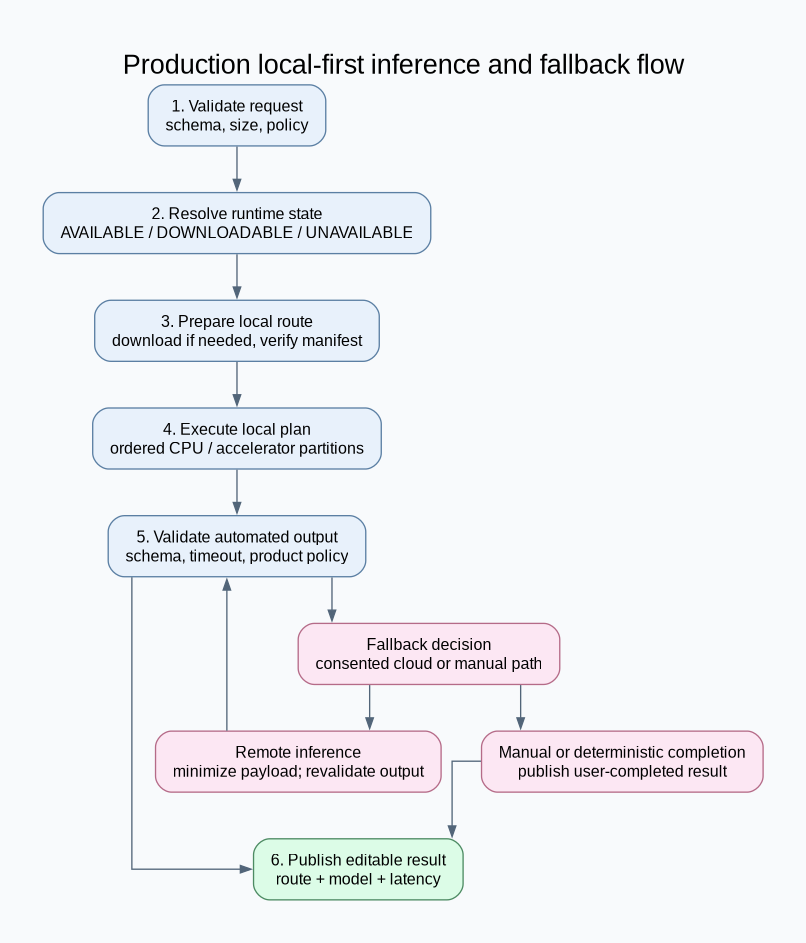
The implementation map below joins the states that are often documented in isolation. It sends verified local execution through ordered CPU and accelerator partitions, applies the same output checks after a consented cloud route, and keeps manual completion available when neither automated route can preserve the user’s task.
Quantization needs task tests and resource tests
The first suspicious result in a compression run is often a success: the smaller candidate loads, median latency improves, and the aggregate quality score barely moves. Split that score by rare label, safety behavior, locale, and structured-output validity before accepting it. Reduced precision changes each model and task differently, so a fleet-wide average can conceal the exact segment that makes the feature useful.
The MobileAIBench study tested model precision from 16-bit down to 3-bit, included task and trust-and-safety evaluations, and measured latency plus resource use on an iPhone 14. Its table reports Llama 2 7B disk usage of 13 GB at 16-bit, 6.7 GB at 8-bit, and 3.6 GB at 4-bit. The framework measures time to first token, input tokens per second, total time, CPU, RAM, and battery drain rate. The study also observed a major performance drop for most tested multimodal models at 3-bit quantization, while model sensitivity varied, so disk reduction needs a paired task-quality result.
MLPerf Mobile v6.0 adds on-device LLM tests for Llama 3.2 1B, Llama 3.2 3B, and Llama 3.1 8B using TinyMMLU and IFEval requests. Devices with enough memory can run the tests on CPU without tailored acceleration; the release also supports NPU execution of the 8B benchmark on Snapdragon 8 Elite Gen 5. That split is a warning against copying a leaderboard number into a release contract without the model, backend, memory class, and acceleration path that produced it.
Suppose a multilingual intent classifier preserves its aggregate score while rare safety labels regress in one locale on older phones. The average conceals the product failure. Group errors by segment and candidate ID in the evaluation output, then join them to a device row containing package bytes, peak resident memory, cold start, warm latency, and sustained battery or thermal behavior. The joined record shows whether the failure belongs to model behavior, runtime behavior, or both.
Apple’s Core ML optimization guide makes the hardware dependency explicit. It supports palettization at 1, 2, 3, 4, 6, or 8 bits, INT4 and INT8 weight quantization, INT8 activation quantization, and pruning. The guide notes that a backend may fully decompress weights before execution and produce latency similar to float16, while another uses fused kernels and reduces data movement. It also identifies W8A8 acceleration on the Neural Engine for newer hardware such as A17 Pro and M4. Package size settles the storage question; only a trace from the required device and compute unit can establish whether compression shortened the user-visible path.
A useful compression record has two unequal halves. The quality half is segmented by rare labels and structured-output validity. The device half records package size, peak memory, cold start, sustained latency, thermal state, and the execution backend for every required tier.
Define task strata, repetitions, cooldown, and the confidence method before opening the results. A small exploratory corpus can expose crashes. Estimating tail behavior and rare-label quality requires enough observations in those exact strata, so the report must carry per-segment sample counts and confidence intervals beside the manual-route decision.
Model activation deserves a transaction
Crash log: the process died after a download replaced half of the active model file. On the next launch, the filename looked valid and the runtime opened corrupt bytes before route selection began. A staging directory changes the evidence: the active pointer still names the previous verified file, and cleanup finds the incomplete artifact outside the serving path.
A downloaded model is executable product state, much like a local database migration: the app stages the file, verifies its identity, and load-tests it away from the active path before a single atomic pointer switch exposes it to requests. Throughout that sequence, the known-good rollback target remains untouched.
Never overwrite the active model in place. A process can be killed during download, storage can fill, or verification can fail. Give every artifact a manifest that the app can validate before activation:
{
  "model_id": "receipt-fields-int8",
  "model_version": "3.2.0",
  "runtime": { "name": "litert", "minimum_app_build": 420 },
  "artifact": {
    "file": "receipt-fields-int8.tflite",
    "bytes": 18743296,
    "sha256": "5f7f20f4f2b48f56c482cfbf3b8ecfc17bd2f163479ee7b0d80f13b3d31c54a5"
  },
  "schema": { "input": 2, "output": 4 },
  "activation": { "policy": "probe_then_switch", "rollback_to": "3.1.4" }
}
The digest above is illustrative rather than a released artifact. A real manifest is generated by the model build, signed or delivered through an authenticated channel, and stored beside immutable model bytes.
import java.io.File
import java.io.FileInputStream
import java.nio.file.Files
import java.nio.file.StandardCopyOption
import java.security.MessageDigest

fun activateModel(
    staged: File,
    active: File,
    expectedBytes: Long,
    expectedSha256: String,
    probe: (File) -> Boolean,
) {
    require(staged.length() == expectedBytes) { "model byte count mismatch" }
    val digest = MessageDigest.getInstance("SHA-256")
    FileInputStream(staged).use { input ->
        val buffer = ByteArray(64 * 1024)
        while (true) {
            val count = input.read(buffer)
            if (count < 0) break
            digest.update(buffer, 0, count)
        }
    }
    val actual = digest.digest().joinToString("") { "%02x".format(it) }
    require(actual == expectedSha256.lowercase()) { "model digest mismatch" }
    require(probe(staged)) { "runtime compatibility probe failed" }

    val previous = File(active.parentFile, active.name + ".previous")
    if (active.exists()) {
        Files.move(active.toPath(), previous.toPath(), StandardCopyOption.REPLACE_EXISTING)
    }
    try {
        Files.move(
            staged.toPath(),
            active.toPath(),
            StandardCopyOption.ATOMIC_MOVE,
            StandardCopyOption.REPLACE_EXISTING,
        )
    } catch (error: Exception) {
        if (previous.exists()) {
            Files.move(previous.toPath(), active.toPath(), StandardCopyOption.REPLACE_EXISTING)
        }
        throw error
    }
}
This JVM routine targets Android API 26 or later because it uses java.nio.file. The probe must instantiate the actual runtime, inspect the expected input and output schema, and execute a tiny fixed tensor. If any check fails, the previous file returns to the active path before the error reaches route selection.
Distribution mode changes the first-use contract
Google Play’s Play for On-device AI beta documentation defines install-time, fast-follow, and on-demand AI packs. Install-time makes the model available when the app opens. Fast-follow starts delivery after installation but lets the user open the app first. On-demand begins only when the app requests the pack, which fits a model needed by a narrow workflow.
The table applies the delivery definitions from Google Play for On-device AI beta documentation to release planning.
| Delivery mode | First-use state | Release evidence | Best fit |
|---|---|---|---|
| Install-time | Ready at first app launch | Installed split and model probe | Core feature that justifies install size |
| Fast-follow | App may open before model arrives | Progress, interruption, relaunch, completion | Common feature that can wait after install |
| On-demand | Download begins inside the workflow | Consent, cancellation, retry, fallback | Optional or infrequent capability |
Google’s delivery limits allow each compressed AI pack to reach 1.5 GB and the generated app version to total 4 GB. Downloads over 200 MB pause off Wi-Fi until the user explicitly agrees to mobile data; the library reports WAITING_FOR_WIFI and REQUIRES_USER_CONFIRMATION states for those gates. Treat both as UI states, preserve the draft, and record the user’s route instead of turning a delivery policy into an inference error.
AI packs contain model assets rather than Java, Kotlin, or native runtime libraries. Those libraries stay in the base or feature module, and Play updates an AI pack with the app binary while using file-level patching when the model hasn’t changed. Bind the app build, pack identity, delivery mode, and model digest in one candidate manifest so a staged rollout can prove which bytes each device executed.
Rollback must work remotely and offline. A remote kill switch can stop new activation, while the app should retain the previous verified file for local rollback. If storage policy allows only one model, preserve a deterministic fallback until the replacement has survived a staged rollout.
Local execution changes the security boundary
Local execution enlarges the client attack surface: model artifacts, preprocessing code, intermediate tensors, and runtime state sit inside an environment the user or malware may control. It also removes a network hop from the normal request path and can limit routine data exposure. The mobile on-device AI security systematization separates that surface into input-level, model-level, and execution-level adversaries, a more useful review frame than the loose claim that local processing is private.
Use three concrete questions during threat modeling. Can crafted input alter the feature’s decision? Can an attacker replace or extract the resident model? Can another local component observe or modify runtime buffers? Digest verification detects accidental corruption and unauthorized replacement when the expected digest comes from a trusted channel. Usable weights or derived runtime state still become available to the local execution path. Hardware isolation narrows exposure only for the operators and buffers that remain inside it, so record every delegation and fallback boundary.
The SafetyCore case study supplies a concrete model-level test: its researchers extracted and manipulated the on-device model used for sensitive-image detection, then bypassed the protection. A release review should repeat that question against its own artifact and runtime materialization. If an attacker changes the model bytes or the post-decryption buffer, which independently enforced control still protects the user?
The same paper catalogs adversarial inputs, backdoors, adversarial weight changes, model stealing, and energy-latency attacks. A production control plan states which outcomes are safety relevant, rejects untrusted model bytes before activation, caps resource consumption, and keeps authorization decisions in a cryptographic or server-enforced layer.
Privacy claims must include storage and telemetry
Camera caches, crash attachments, analytics events, keyboard history, backups, screenshots, and cloud fallback can still move or retain sensitive content after inference runs locally. Inspect app storage and outbound traffic under success, cancellation, crash, and fallback conditions, with the test payload marked so an unexpected copy is easy to identify.
Trace one note through the feature from app storage to prompt buffer, draft summary, cancellation, and process death. Keep the raw note under the app’s declared retention policy. Release the prompt buffer after inference. Telemetry receives model version, route, duration bucket, and success state. A cancellation race deserves its own trace because crash and analytics SDKs often observe a different cleanup path.
Google’s GenAI Summarization API documentation states that input must stay under 4,000 tokens and lists support for English, Japanese, and Korean. It also says availability can differ by device configuration and recommends checking feature status at runtime. These are product constraints: truncation needs a user-visible policy, unsupported languages need another route, and availability can’t be inferred from OS version alone.
Model extraction is another boundary. Treat an app-bundled model as recoverable by a motivated attacker, even when the file is encrypted at rest, because the runtime must eventually materialize usable weights or derived state. Keep server secrets, private policy, and irreversible trust decisions out of those bytes. The mobile supply chain security plan complements this model lifecycle with dependency provenance and artifact controls.
Test across time, heat, and route changes
Picture a live-caption feature that passes its first utterance, warms the runtime, then runs for ten minutes while a user records an interview. During that session the app backgrounds once, receives a memory warning, loses connectivity, and returns with the device already warm. A production test plan has to preserve the transcript, route, and editing state through that sequence.

- Validate input and output schemas, cancellation, timeout handling, and lifecycle cleanup with deterministic tests.
- Run a versioned task corpus and report errors by class, language, device, and any business-critical segment.
- Measure cold start, warm calls, sustained loops, background interruption, low-memory recovery, and thermal throttling on representative phones.
- Force every availability transition and confirm that local, cloud, rules, and manual routes preserve the promised outcome.
- Stage the model separately from the app and verify pause, rollback, and kill-switch behavior before broad rollout.
Five quick loops can all land in the device’s initial performance envelope. Continue camera or token-generation workloads until both latency and thermal state settle, preserve every iteration timestamp, then repeat after a controlled cooldown. The detailed mobile thermal throttling plan shows how to separate a frequency transition from a model regression when the later samples diverge.
Route-change tests should background the app during sustained inference, apply memory pressure, and compare the execution plan after thermal throttling or delegate loss. Relaunch with the previous editable result still present. The app’s fallback may depend on local records, so the offline-first mobile sync architecture is relevant when results must later reconcile with a server.
A release contract that can stop rollout
The release contract below separates measured evidence from chosen acceptance criteria. Teams fill the “candidate evidence” column from a reproducible run, while the threshold column records the product decision. Every evidence cell must name results from the current candidate; an empty cell blocks rollout because no earlier model run can establish the behavior of new bytes on this fleet.
| Gate | Proposed threshold | Candidate evidence | Failure action |
|---|---|---|---|
| Task quality | Product-owned minimum by segment | Corpus ID, sample count, metric, confidence | Keep prior model |
| Responsiveness | End-to-end p95 by device tier | Trace stages and device build | Pause affected tier |
| Memory and heat | No product-defined pressure or thermal breach | Peak memory, duration, thermal state | Disable local route |
| Availability | Fallback succeeds for every unsupported state | State-transition test report | Block release |
| Privacy | No prohibited payload in logs, cache, or fallback | Storage and traffic inspection | Block release |
| Rollback | Rehearsal restores known-good route | Activation and rollback log | Block model rollout |
Evidence ownership can follow the table rows. ML supplies task evaluation. Mobile attaches lifecycle and resource traces; privacy signs the storage and traffic inspection; release engineering adds the activation and rollback log. Bind each row to one candidate ID and content digest. Without that join key, a passing quality report from model A can be combined accidentally with a thermal trace from model B and a rollback rehearsal from an older app build.
Store the packet as an append-only evidence chain: candidate manifest, corpus revision, per-device traces, privacy inspection, approval decision, and rollout event. Every derived dashboard should link back to those immutable inputs. A later model conversion can then invalidate only the affected evidence instead of forcing reviewers to guess which green checkmarks still apply.
Start with one model version on one internal device tier and keep its evidence bundle intact: candidate ID, device build, route, quality corpus, stage timings, thermal trace, and rollback rehearsal. Expansion to the next cohort happens after those rows remain healthy. Product telemetry then compares correction rate and abandonment with the baseline workflow, while successful fallback counts reveal whether a local failure still lets the user finish the task.
When local inference is the wrong choice
Keep inference off the phone when current knowledge, large context, server-only data, or centralized policy dominates the requirement. A cloud service is easier to update instantly and can use larger models. Its lifetime cost can also beat local execution after model operations, device-specific defects, download bandwidth, and support burden are counted.
An attacker controls the client environment and can tamper with model inputs, binaries, and outputs. Assign interface assistance to the local model. Assign authentication and authorization to cryptographic protocols and server-side policy. The site’s mobile passkeys blueprint applies that separation to account access, where signed challenges establish identity.
A note app can detect dates with platform data detectors, search known entities through a local index, and reserve generation for short paraphrases. Those paths are smaller, easier to test, and simpler to explain than a general model. Build the deterministic baseline first so the AI candidate has a real opponent and the product retains a fallback when a release gate fails.
A hybrid route is appropriate when only part of the fleet can run the model well. Make consent, semantics, and observability consistent across routes. Avoid a hidden cloud fallback for content that users were told would stay on the device.
Frequently Asked Questions
Can an on-device model be updated without an app release?
Yes, if the app owns a signed or digest-verified model delivery channel and the runtime supports loading external artifacts. Stage each file, verify compatibility, test-load it, and switch activation atomically. Keep a known-good rollback artifact. Platform-managed models follow the operating system’s delivery lifecycle instead, so the app must observe availability and behavior rather than assume a fixed model version.
Should model files be encrypted inside the app?
A determined attacker controls the client and can observe the model after the app decrypts or maps it for inference. Encryption still protects files at rest and raises extraction cost. Integrity verification catches replacement, while credentials and irreversible security policy remain off the client. Extraction resistance is a defense-in-depth control with that explicit ceiling.
How should a team compare battery impact between candidates?
Run the same task corpus, output limits, screen state, and device build after a controlled cooldown. Record energy or battery change alongside duration, thermal state, and completed work, then repeat with candidate order randomized. Efficiency is energy per useful completed task; this denominator accounts for output length and accelerator-route differences that raw run duration hides.
What telemetry is safe for private local inference?
Collect operational metadata that can’t reconstruct user content: feature name, model version, route, availability state, coarse latency bucket, success, fallback, and user correction when consented. Exclude prompts, generated text, images, embeddings, filenames, and free-form errors that may contain payloads. Test crash reporting and analytics traffic because SDK defaults can violate an otherwise careful local-processing design.
Does offline inference eliminate all network dependencies?
No. First-use model or adapter downloads, license checks, remote configuration, and system-service initialization may still require connectivity. Once the required artifacts are present, inference can run offline if the chosen runtime supports it. Test fresh install, interrupted download, expired configuration, and airplane-mode relaunch separately. Product wording should distinguish “works offline after setup” from “needs no network at any point.”
Put the first candidate through a real gate
The finished release packet should contain a suitability score, a versioned evaluation corpus, traces from representative devices, an availability transition report, storage and traffic inspection, and a rollback rehearsal. Together, those records show whether the candidate is ready for a staged cohort.
- Score the task with the Local Inference Suitability Matrix before committing to a runtime.
- Write thresholds as proposed acceptance criteria and keep measured evidence in separate fields.
- Evaluate quantization on task quality plus device resources, with errors segmented by product-relevant groups.
- Activate downloaded models transactionally and rehearse rollback before exposing a broad cohort.
- Measure the complete gesture on representative devices, including cold state and sustained thermal load.
Start with one candidate in a low-risk cohort. Release engineering reaches the expansion control and finds an empty rollback row, so the cohort remains on the previous route even though availability and task quality have passed. The team runs the failed activation exercise, attaches the restored model ID and timestamps, and then reopens the decision.