
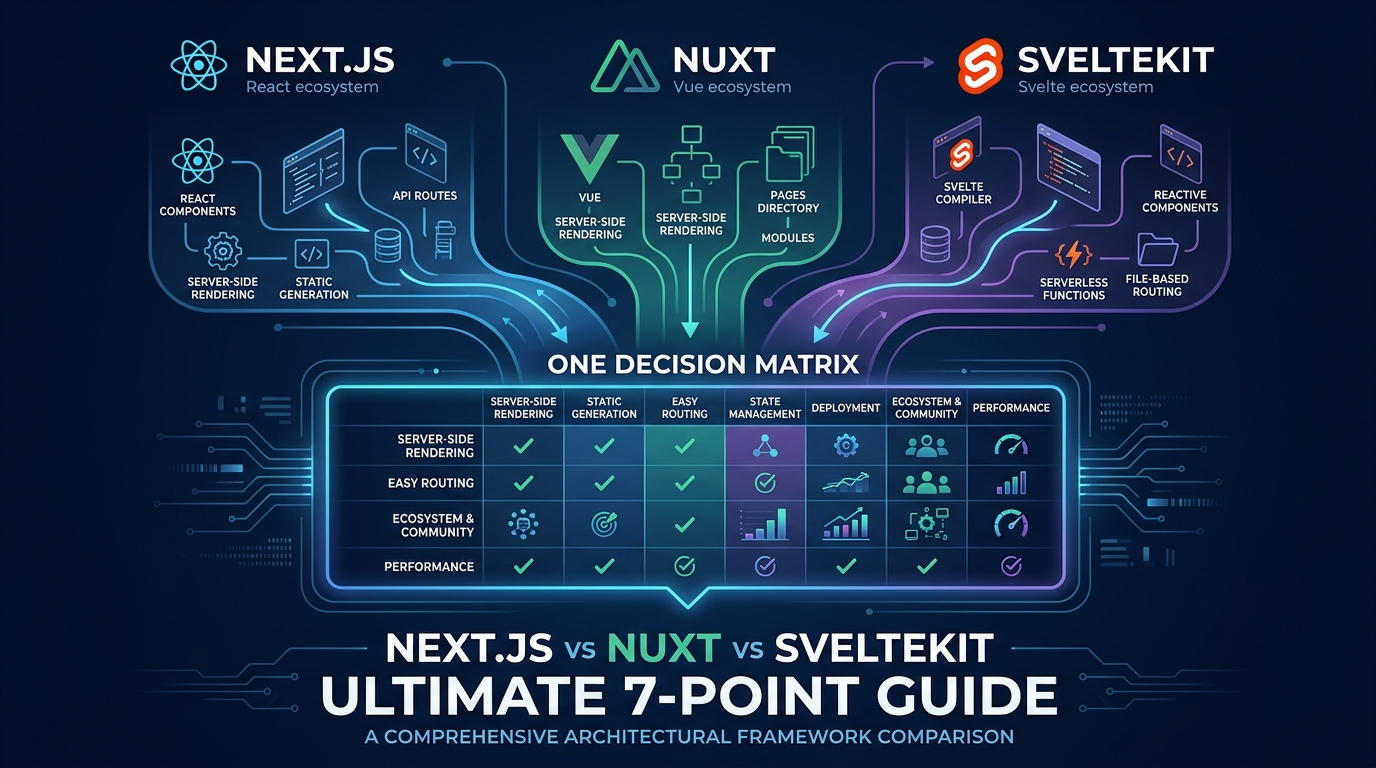
A framework comparison becomes expensive when it treats component syntax as the decision. Next.js, Nuxt, and SvelteKit all produce capable web applications. The lasting differences sit deeper: who owns cache invalidation, how a route becomes static or dynamic, what crosses the server-browser boundary, and whether the deployment target preserves the framework’s semantics.
Next.js vs Nuxt vs SvelteKit: this seven-point comparison evaluates current stable lines through a workload contract instead of a synthetic leaderboard. The scope is Next.js 16.2 with React 19.2, Nuxt 4.5 with Vue 3.5, and SvelteKit 2.70 with Svelte 5.56. Patch releases will move; the rendering, cache, deployment, and ownership boundaries are the durable part of the decision.
The article adds two reusable artifacts. First, a route-semantics contract forces a team to specify freshness, personalization, mutation, and failure behavior before choosing a rendering mode. Second, a weighted decision matrix separates launch convenience from maintenance risk. That separation matters because launch convenience and long-term operating cost come from different evidence. Cache ownership, security patching, observability, and adapter support each need an accountable maintainer.
Use this analysis if you’re selecting a full-stack JavaScript framework for a new product, questioning an inherited choice, or planning a migration. The route contract, workload test, and maintenance rubric expose failure points before anyone spends a week polishing a proof of concept. The programming, web development, and JavaScript framework hub groups the route rendering, cache invalidation, deployment portability, and framework comparison material evaluated here.
1. Start with the product boundary
Pick the component ecosystem first only when the product is mostly client-side UI. For a server-rendered application, the better starting point is the product boundary: which routes contain public content, which depend on identity, which mutate data, and which must survive a stale origin or failed deployment region?
A meta-framework combines a component system with routing, server rendering, data loading, build output, and deployment conventions. It saves integration work by making those decisions together. The same coupling raises switching cost. A route written around one framework’s cache tags or server-only modules rarely moves by changing imports.
Suppose a company already maintains a React design system, trains reviewers on React semantics, and buys several React-only integrations. Recreating those assets may outweigh a cleaner routing model elsewhere, so Next.js begins with a real advantage. A Vue organization can make the same argument for Nuxt and gain Nitro’s route rules. SvelteKit enters from another direction: teams willing to retrain can trade inherited ecosystem reach for explicit route files and compiler-led control over browser work.
Before opening a starter repository, write four route classes on one page:
- Public and immutable until the next deployment, such as legal pages.
- Public with controlled freshness, such as catalog and editorial routes.
- Personalized on every request, such as an account dashboard.
- Mutation endpoints whose success must invalidate or bypass cached reads.
Then mark hard constraints: required cloud, self-hosting policy, regional execution, existing identity provider, browser support, accessibility commitments, and the team’s primary component ecosystem. A candidate that fails the region or identity requirement leaves the matrix before scoring, with the failed requirement recorded in its decision row.
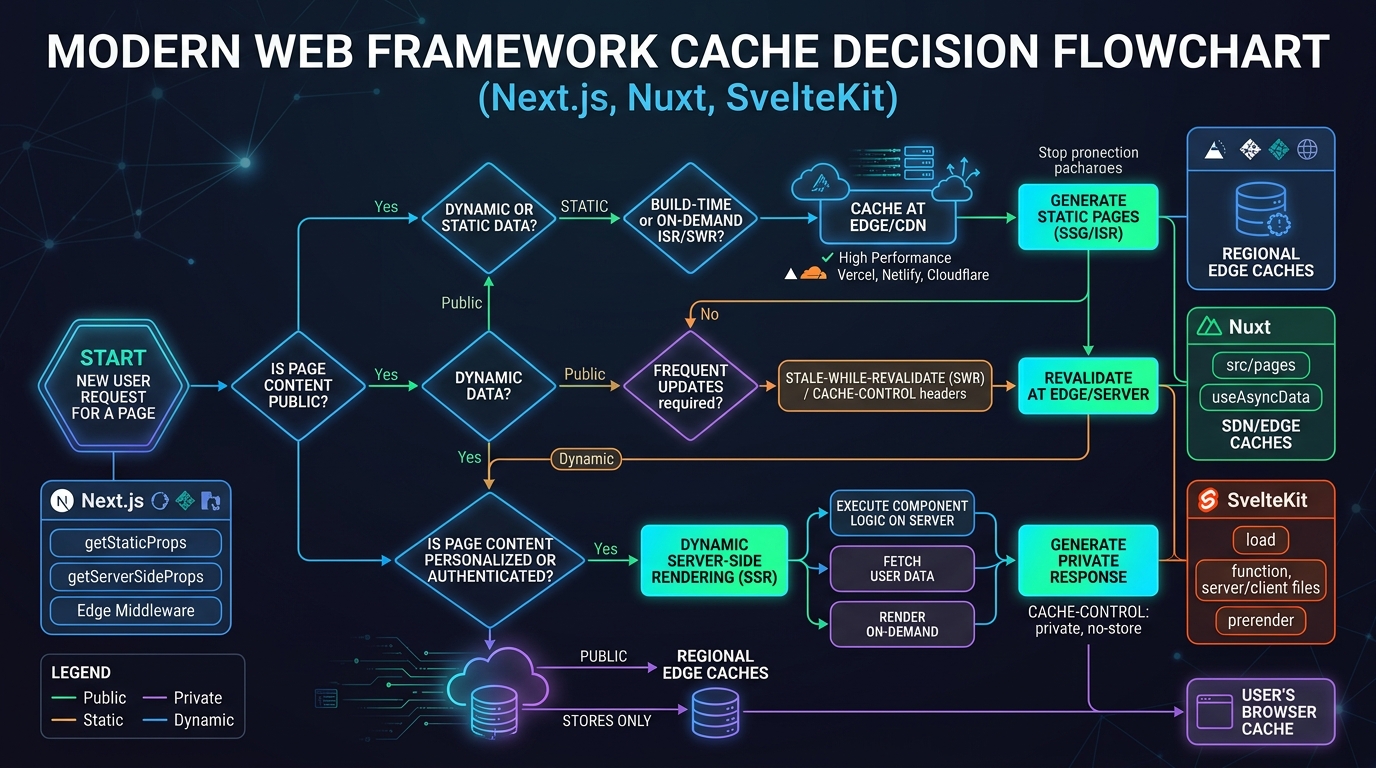
A framework’s happy path can conceal a boundary mismatch for months. A personalized response cached as public exposes account data. At the other extreme, rendering an editorial archive on every request raises origin load and tail latency even though publication changes are infrequent. Before the proof of concept starts, assign each route an identity source, cache scope, freshness budget, and invalidation owner. The opening contract is the only place that defines this evidence discipline; later tests use it without restating it.
2. Rendering labels hide different contracts
A visitor opens a product page from a campaign URL and receives a personalized price from a cache entry whose key omitted the customer segment. Was the read cached, did hydration reuse serialized data, or did invalidation miss the route? The answer depends on the framework’s rendering controls and on where identity enters the request.
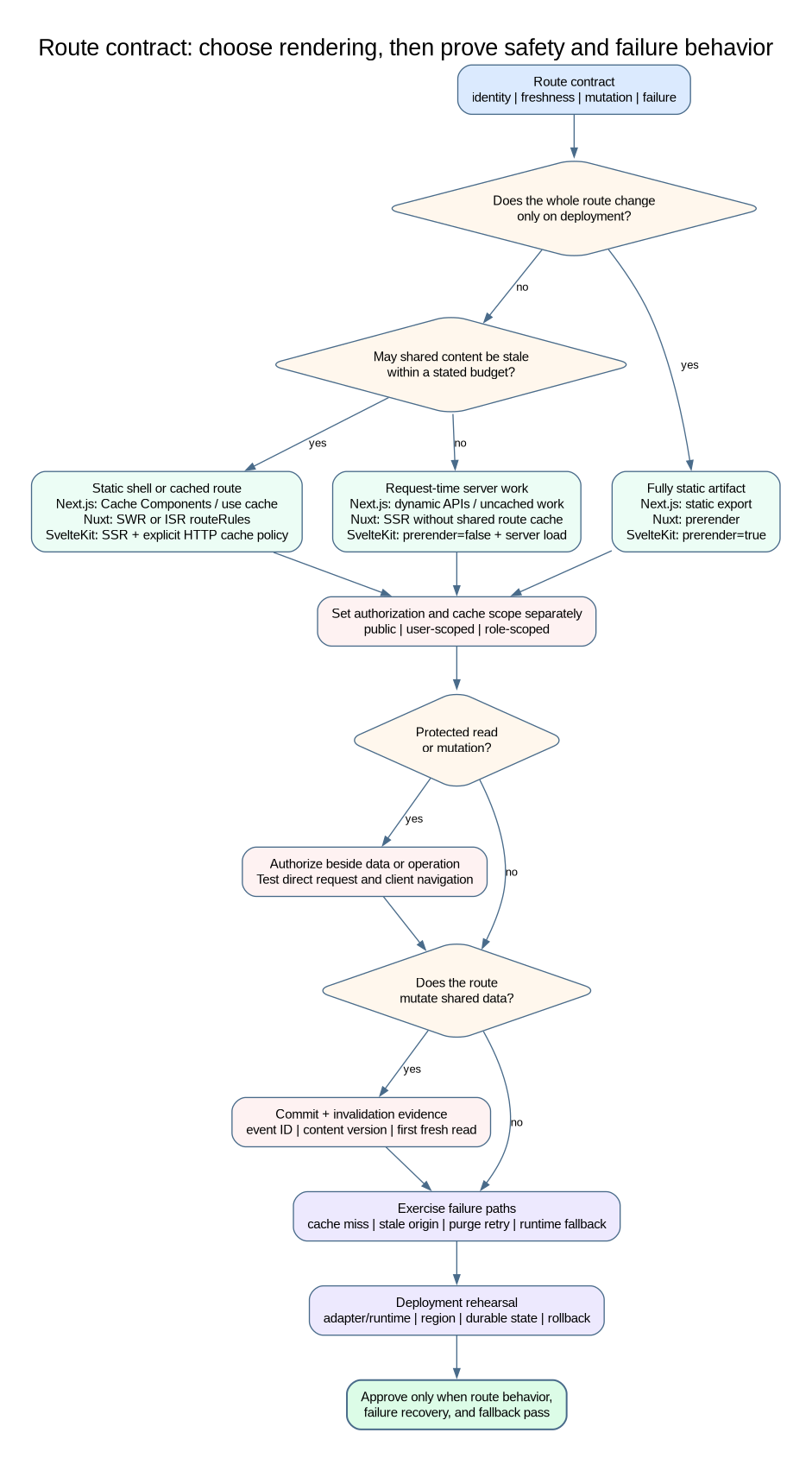
With Next.js Cache Components enabled, deterministic work and values marked with use cache enter the static shell. The function arguments participate in the cache key:
import { cacheLife, cacheTag } from 'next/cache'

export async function getProduct(productId: string) {
  'use cache'
  cacheLife('minutes')
  cacheTag(`product:${productId}`)
  return db.product.findUniqueOrThrow({ where: { id: productId } })
}
Request-dependent content belongs behind a Suspense boundary and streams later. In a serverless process whose memory disappears between requests, the default in-memory entry may be recomputed; the official caching documentation points durable shared caching toward a remote cache strategy. Passing a session or other high-cardinality value into cached work creates a separate entry for every distinct argument.
Nuxt uses universal rendering by default. Its rendering modes reference places route behavior in routeRules; Nitro wraps matching routes with its cache handlers. A representative contract can be expressed directly:
export default defineNuxtConfig({
  routeRules: {
    '/pricing': { prerender: true },
    '/products/**': { swr: 300 },
    '/account/**': { ssr: true },
  },
})
Hybrid rendering isn’t available through nuxt generate, so a static-output decision removes the server-backed behavior shown above. The product route’s swr value is an acceptance criterion chosen by the team, while the account route still needs an explicit test proving that personalized output never enters a shared cache.
SvelteKit exports page options from route or layout modules, and the three switches are independent:
// src/routes/catalog/[slug]/+page.js
export const prerender = 'auto'
export const ssr = true
export const csr = true
The page options reference explains that prerender = true removes a route from the dynamic SSR manifest, while 'auto' retains a dynamic fallback. Turning off CSR also removes client JavaScript, component scripts, progressive form enhancement, and client-side routing for that route, which can suit a content page only when the lost behavior is intentional.
The route-semantics contract
Build this table for representative routes before the proof of concept. Treat the values as acceptance criteria for the team’s test harness. A route fails as soon as its observed behavior breaches one of those limits. The benchmark row records the breached limit beside the median and excludes the route from approval.
| Route | Identity | Freshness contract | Mutation and purge | Failure evidence |
|---|---|---|---|---|
| /pricing | Public | Changes only after approved content release | Deploy replaces artifact | Build manifest plus HTTP cache headers |
| /products/[id] | Public | Team sets a maximum stale interval | CMS event purges product key | Content version, cache age, purge ID |
| /account | Per user | Fresh on authenticated request | Mutation refreshes affected user view | User-scoped trace with cache outcome |
| /admin/import | Privileged | Never publicly cached | Job completion emits scoped invalidations | Job ID, actor, affected keys, retry state |
A product response should expose its content version, cache age, and purge ID so operators can reconstruct which publication event produced it. A missing purge ID prevents operators from separating a dropped CMS event from delayed propagation. The route then fails the observability requirement even if its current response happens to be fresh.
3. Data flow determines the debugging surface
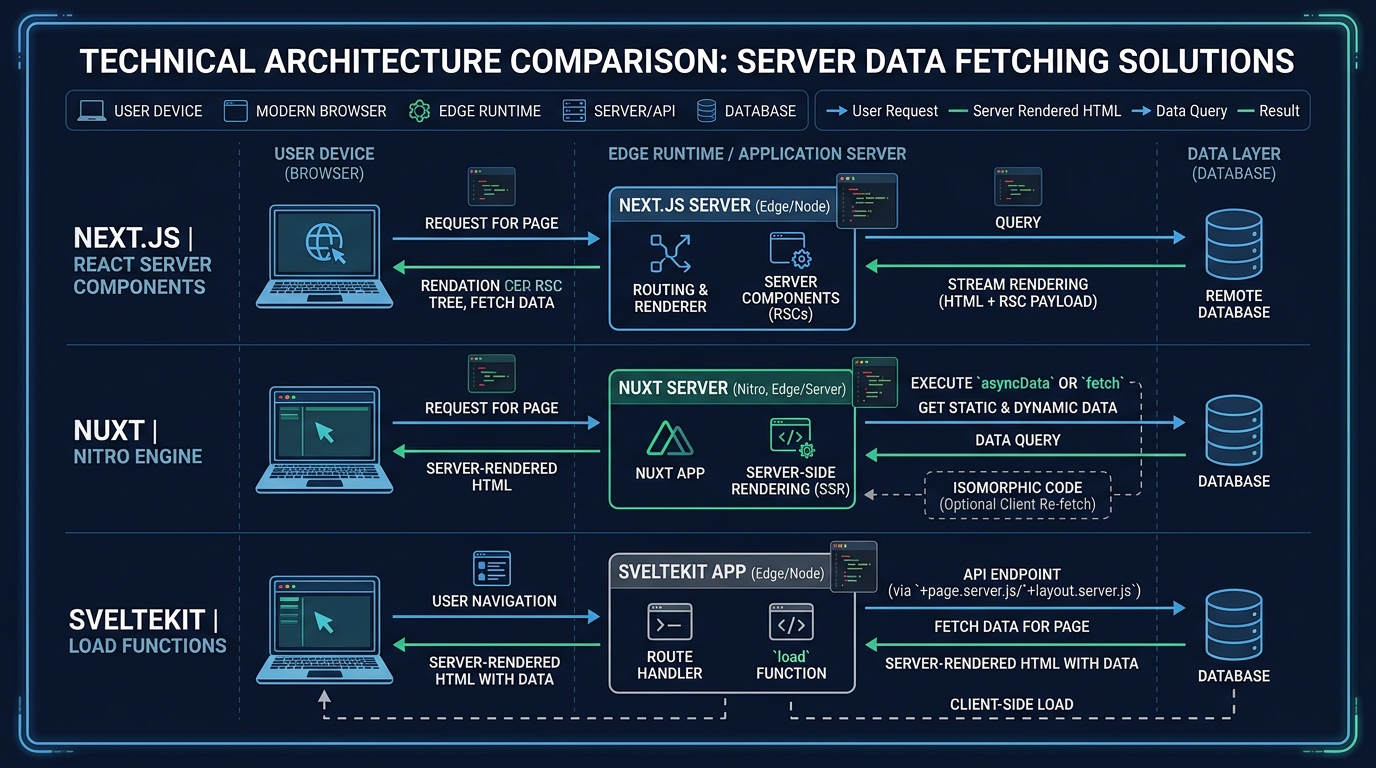
Follow a checkout value from its loader through authorization and serialization to the browser, then keep tracing until mutation invalidation finishes. The database commit succeeds, then cache invalidation times out. Payment exists while the next cart read still resolves to the previous version. Framework boundaries determine which span can prove that split.
Replay the authorization result against each server-browser boundary and confirm the denied state survives client navigation. Next.js exposes the affected tags through updateTag or revalidateTag. Inspect the Server Components payload too, because a cookie or header passed into cached work changes the key space. In Nuxt, compare the server-side useFetch payload with the client hydration payload, then check whether enabled cancelled an in-flight refresh. Experimental SSR streaming adds a hard timing boundary: after the first byte, later status, header, or cookie mutations can’t reach the client, and incompatible route rules fall back to buffered rendering according to the Nuxt 4.5 release notes.
SvelteKit gives the trace a different shape. Universal and server-only load functions, form actions, and endpoint handlers are visible in route filenames; during SSR, enhanced fetch can call an internal handler without an HTTP hop. Data read through text or json is captured into rendered HTML for hydration reuse. Response headers appear in that path only when the application explicitly allows them, so a missing browser header and a duplicate request point to different faults.
The trace below isolates the failure boundary:
'use server'

import { updateTag } from 'next/cache'
import { redirect } from 'next/navigation'
import { db } from '@/lib/db'

export async function completeCheckout(cartId: string): Promise<never> {
  await db.transaction(async (tx) => {
    await tx.order.create({ data: { cartId, status: 'paid' } })
    await tx.cart.update({ where: { id: cartId }, data: { status: 'closed' } })
  })

  updateTag(`cart:${cartId}`)
  updateTag('orders')
  redirect(`/orders/${cartId}`)
}
This runnable Next.js Server Action commits the order and cart changes inside one database transaction, then calls updateTag for both affected cache tags before redirecting. Immediate tag expiry gives the redirected order page read-your-own-writes behavior.
// server/api/checkout.post.ts (Nuxt/Nitro)
export default defineEventHandler(async (event) => {
  const actor = await requireUser(event)
  const { cartId } = await readBody<{ cartId: string }>(event)
  const result = await checkoutService.complete({ actorId: actor.id, cartId })
  const invalidationId = await invalidationOutbox.publish({
    keys: [`cart:${cartId}`, 'orders'], version: result.version
  })
  return { orderId: result.orderId, version: result.version, invalidationId }
})
The handler returns the committed content version and durable invalidation ID. The acceptance test waits until a server read reports the committed version. The client can then refresh its useFetch key and display the server-reported content version beside the order state.
// src/routes/checkout/+page.server.ts (SvelteKit)
import { fail, redirect } from '@sveltejs/kit'

export const actions = {
  default: async ({ locals, request }) => {
    if (!locals.user) return fail(401)
    const cartId = String((await request.formData()).get('cartId'))
    const result = await db.transaction((tx) =>
      checkoutService.complete(tx, { actorId: locals.user.id, cartId })
    )
    const invalidationId = await invalidationOutbox.publish({
      keys: [`cart:${cartId}`, 'orders'], version: result.version
    })
    if (!invalidationId) return fail(503, { retry: true })
    redirect(303, `/orders/${result.orderId}?version=${result.version}`)
  }
}
An enhanced form reruns the relevant loads after success. That browser refresh remains separate from the server or CDN purge, which the content version and invalidation event must prove.
Payment exists while the cart still shows its previous state. Rejected writes and partial upstream failures need separate traces because their instrumentation often disappears before the success-path spans would have been emitted.
For applications with native clients alongside the web UI, resist hiding domain behavior inside framework-only server functions. Keep a stable service or API boundary where multiple clients need the same contract. This concern resembles the boundary discipline used when choosing among Flutter, React Native, and Kotlin Multiplatform: framework convenience is strongest inside its intended ownership boundary.
4. A workload-specific benchmark plan
Public framework benchmarks rarely share component trees, data sources, deployment regions, cache state, or build modes. A single ranking collapses several costs into one number and encourages a false conclusion. Measure the journeys your product must serve.
The Next.js 16.2 release report attributes an HTML-rendering improvement to replacing a JSON.parse reviver with plain parsing followed by a JavaScript walk. Its four listed examples move from 19 ms to 15 ms, 80 ms to 60 ms, 43 ms to 32 ms, and 52 ms to 33 ms. Using the original time as the denominator, those pairs correspond to reductions of about 21%, 25%, 26%, and 37%; the report separately summarizes gains of 25% to 60% across its tested applications. The mechanism isolates a real RSC payload-deserialization cost. For the cross-framework run, keep the application, infrastructure, cache state, instrumentation, and request sequence identical across all three candidates.
| Workload | Events to retain | Failure exposed |
|---|---|---|
| Public content route | Cold origin render, warm cache response, transferred payload, browser JavaScript, purge completion | A fast warm response masking slow origin work or stale content |
| Authenticated application route | Server time, client startup, navigation, mutation commit, first fresh read, recovery path | A role revocation that still permits client navigation, or an error boundary that can’t recover the protected segment |
Run both as production builds on the target adapter and region. Record p50 and p95 after a documented warm-up, with the sample count fixed before anyone sees the results.
Freeze the build identity and runtime environment in the test record before sending the first request. That keeps later regressions attributable to a code, adapter, or infrastructure change.
- Build identity
- Git commit, lockfile hash, runtime, framework, adapter, region, and build command.
- Request record
- Cache state and key, response status, server duration, transferred bytes, and browser JavaScript.
- Browser profile
- A named device and network profile, with Largest Contentful Paint, Interaction to Next Paint, and Cumulative Layout Shift collected according to the Web Vitals definitions.
- Mutation interval
- The full interval from database write to the first read that observes the new value, including every span between them.
For one review, the decisive artifact may be an editorial publication test beside a production histogram: a scheduled article appears after its release time, preview content never reaches the public cache, and the publish span ends only when the new revision is readable.
5. Deployment portability has three layers
The fallback starts after a successful build. The first container replacement drops an in-memory scheduled job queue, so a portability test must prove that pending work survives a new instance or moves to durable storage. Authentication survives, the image upload fails because its storage credential never moved, and the CMS purge event has no listener. A Cloudflare KV-backed route now needs a Node-side substitute whose consistency behavior may differ from the original binding.
| Layer | Portable surface | Fallback question |
|---|---|---|
| Build | Next.js stable Adapters API, Nuxt Nitro presets, and official SvelteKit adapters | Does the same commit produce runnable output? |
| State | Provider cache, KV, object storage, scheduled work | Which consistency and lifecycle guarantees changed? |
| Operations | Logs, purge hooks, streaming, rollback | Can the team diagnose and reverse a stale deployment? |
This resembles the sustained-load method used for mobile thermal throttling. The fallback’s behavior will drift as runtimes and adapters change, especially around provider storage and cache integrations.
6. Security and maintenance can reverse the choice
On February 27, 2025, researchers disclosed what became CVE-2025-29927. The initial report covered an older Next.js line and received lower priority; broader impact reached the framework team in March, patches followed on March 17 and 18, and the advisory became public on March 21. The maintenance comparison starts inside that delay.
The Next.js middleware bypass incident shows why runtime ownership matters. Vercel’s CVE-2025-29927 postmortem explains that the internal x-middleware-subrequest header prevented recursive middleware execution and could be abused to bypass middleware. The vulnerable execution path ran through self-hosted applications using next start or standalone output. Several platforms with decoupled routing avoided that path. The report explicitly warns against using middleware as the sole route protection layer.
The deployment distinction was concrete. Static exports had no Middleware server runtime and were outside the affected path; Vercel, Netlify, and Cloudflare Workers used decoupled routing that didn’t share the vulnerable execution path. Exposure depends on the enabled experiment, adapter, origin checks, proxy behavior, and patch line. Inventory those surfaces as separate deployable units. The incident record also had to include the adapter, routing owner, and whether an upstream layer filtered internal headers.
The engineering lesson is broader than one framework. Authorization belongs next to protected data or operations, even when edge middleware provides an early rejection. Test a direct request to every protected endpoint with middleware bypassed. Also record which deployment layer strips internal headers, because infrastructure altered the incident’s impact.
Nuxt 4.5 introduced stable error codes for an expanding set of build and runtime faults, while moving major build dependencies to Vite 8, Rspack 2, and unhead 3. Its release notes also mark SSR streaming as experimental and off by default. Streaming commits status and headers with the first bytes, so later calls that change status, headers, or cookies can’t reach the client; routes using redirect, cache, ISR, SWR, noScripts, or ssr: false fall back to buffered rendering. Custom plugins and response mutation deserve a route-level test before enabling it.
SvelteKit’s maintenance evidence now includes a useful failure map. The official Svelte security notice lists five patched vulnerabilities across devalue, Svelte, SvelteKit, and adapter-node. Two details change deployment review: experimental remote functions exposed affected devalue.parse paths to user-controlled parameters, while a separate prerendering issue could become SSRF on adapter-node when ORIGIN wasn’t configured and no reverse proxy validated the Host header. An inventory must include enabled experiments, adapter version, origin configuration, and proxy behavior.
One practical drill follows the same chronology. Rebuild a disposable branch from its lockfile, send authenticated requests directly to protected endpoints with middleware bypassed, and compile every supported adapter. If an adapter pins an incompatible dependency, stop there and retain the package constraint plus the unresolved owner. That stalled branch consumes security-review time until the responsible adapter or application owner ships a verified patch.
7. Score launch fit and maintenance fit separately
One score hides timing. Teams often overweight initial familiarity and underweight cache ownership, provider coupling, and upgrade capacity. Use two views of the same criteria: launch fit for the next release and maintenance fit for the operating horizon.
| Criterion | Launch weight | Maintenance weight | Evidence required |
|---|---|---|---|
| Team ecosystem fluency | 25% | 10% | Timed feature and review exercise |
| Route semantics fit | 25% | 25% | Passing route contract and purge trace |
| Target workload | 20% | 20% | Reproducible production-build measurements |
| Deployment and fallback | 15% | 20% | Two-target deployment rehearsal |
| Security and upgrade capacity | 10% | 20% | Patch drill, owner, and supported-version policy |
| Migration escape cost | 5% | 5% | Inventory of framework-bound modules |
Each column sums to 100%. Candidate scores run from one to five and multiply by the approved weight. In the worked sheet, a candidate that can’t place authenticated execution in the required region loses portability points; measured user journeys supply the workload row.
Reusable components and reviewer fluency reduce launch work immediately in the incumbent ecosystem. Unowned cache and provider obligations raise the maintenance score in a React-heavy repository. UI familiarity remains separate launch evidence. In a Vue codebase, custom Vite or Nitro integrations may dominate upgrade work. A SvelteKit team can inherit the same burden through integrations it must build and support itself; the matrix exposes who pays after launch.
Choose none of them when the product is a mostly static content site with minimal interactivity and a simpler generator meets the route contract. Avoid a framework-owned backend when several non-web clients share complex domain workflows. And reject any candidate that fails a hard constraint even if its weighted average is highest.
Which framework should you choose by scenario?
| Scenario | Default | Override |
|---|---|---|
| React team shipping a mixed static and dynamic commerce application | Choose Next.js | Override this default when a required deployment target cannot reproduce its cache or runtime behavior. |
| Vue team operating content-heavy routes with route-level rendering rules | Choose Nuxt | Pick another option when an adapter or regional constraint fails the deployment rehearsal. |
| Small team that values explicit page options and minimal framework surface | Choose SvelteKit | Use Next.js or Nuxt when an existing React or Vue platform ecosystem dominates maintenance cost. |
| Mostly static documentation with no server mutations | Use the simplest static output supported by the team’s stack | A full meta-framework is unnecessary when plain static generation satisfies every route contract. |
Treat these defaults as provisional recommendations. A hard regional, identity, adapter, or rollback constraint overrides the scenario pick before weighted scoring begins.
Migration is a boundary exercise
A migration succeeds when teams move contracts in slices. Rewriting every component first keeps the riskiest server and cache assumptions until the end.
Estimate replacement designs before assigning one blended rewrite size. Start with routes and server endpoints, then follow their dependencies into authentication, cache keys, invalidation calls, image transforms, scheduled work, middleware, environment access, and provider APIs. A product page might carry portable domain queries, ecosystem-bound components, a framework cache tag, and a provider image transform. Four owners and four estimates expose the migration work more clearly than one page count. The estimate should name the adapter replacement, identity integration, and rollback owner, and the final approval keeps the route-specific evidence beside the selected framework.
Move one vertical slice with a public read, authenticated read, mutation, error path, and rollback. Keep the old and new versions behind traffic controls, then compare status, freshness, authorization result, and canonical URL. A mismatch report should identify the route and the exact invariant; visual screenshots cover only the last part of that record.
For a large system, establish an API boundary before changing views if business behavior is trapped in framework server functions. Shared schemas and contract tests can let old and new routes coexist. A team deploying compact AI services may recognize the same separation from small language model deployment: model or framework selection stays reversible only when operational contracts sit outside the replaceable implementation.
In the migration slice, the inherited identity adapter depended on provider-specific session claims. The replacement had to reproduce revocation, role refresh, and callback validation before traffic moved. The migration stopped because the replacement changed image negotiation and cache headers; the original route stayed active until the substitute passed the same browser matrix.
Frequently Asked Questions
Can these frameworks share a component library?
Design tokens, CSS, icons, accessibility requirements, and framework-neutral web components form a practical shared layer. React, Vue, and Svelte then implement their own component execution models. Runtime reuse through web components is worth considering when measured duplication exceeds wrapper and test costs, and when the boundary preserves events, forms, and server rendering.
How long should a proof of concept run?
The prototype ends when each candidate has comparable traces for public, personalized, mutation, and failure routes on the intended deployment target. One narrow vertical slice per candidate is often enough when the same engineers, data contract, and acceptance criteria apply throughout.
Should hiring availability decide the framework?
Hiring belongs in the matrix, though it shouldn’t erase runtime constraints. Measure internal fluency, local candidate supply, onboarding time, and review capacity separately. React familiarity can improve a Next.js launch, while weak understanding of Server Components or caching can still create operational risk. Vue or Svelte expertise may produce a smaller, more coherent ownership group. Use actual hiring and exercise data instead of ecosystem reputation.
Does SvelteKit’s smaller client runtime guarantee better Web Vitals?
Images, fonts, third-party scripts, data waterfalls, server latency, and application code often dominate field metrics. Compiler output can still reduce the narrower share of work attributable to the framework runtime. SvelteKit can also ship substantial JavaScript when the product needs it. Compare production builds using the same UI, data, device profile, and deployment region. Field monitoring should confirm the laboratory result after launch. Break down Core Web Vitals by route template, device class, and deployment region before treating a regression as framework-wide.
Can Nuxt or SvelteKit replace Next.js on Vercel?
Both have official Vercel adapters. Compare the emitted runtime, region selection, cache headers, image service, and environment bindings after deployment because these outputs can diverge even when both builds exit successfully. Test route caching, streaming, image behavior, server APIs, regional execution, logs, and rollback on the exact plan you intend to buy. Provider support can differ by feature even when all routes render. Keep an alternative deployment rehearsal if avoiding platform dependence is a stated requirement.
Choose with evidence you can replay
The decision record names the selected candidate and each veto. It also carries weighted totals plus residual risks, so a reviewer can see whether authorization behavior, platform substitution, or maintenance ownership drove the result. For this worked method, regional execution limits lower portability when authenticated data must stay inside an approved boundary. Measured user journeys supply the workload score, while meeting notes remain supporting context.
- Write the route-semantics contract before building a prototype.
- Treat hard constraints as vetoes, then score launch and maintenance fit separately.
- Benchmark representative journeys with production builds and recorded cache state.
- Rehearse the preferred deployment and one fallback, including rollback.
- Keep authorization beside protected data and test it without middleware.
For a subscription product, the worked slice might include a prerendered policy page, a delayed editorial release, a role-protected account route, and a scheduled renewal job. If two candidates survive the vetoes, replay an authorization regression: revoke a role, invalidate the session, and verify both server navigation and client navigation deny the protected route. That test separates candidates through authorization semantics. Approval requires the same denial on a direct request, a client navigation, and a stale session.
Incomplete evidence leaves a cell unscored and blocks approval. The rubric never guesses a value from team preference. If two candidates remain close, introduce a build-time content error in a prerendered route and verify the build fails with an attributable source path. Then repeat the adapter-specific deployment fallback. A framework that wins component familiarity but loses either recovery test has exposed the cost that the weighted total was averaging away.